Shoulder to shoulder with countries like the Netherlands, Germany, Denmark and the Scandinavia nations, Japan likewise features a great number of cyclists. The Japanese cycle for all reasons - for commuting to work, grocery shopping, sending their children to school, or simply to enjoy their surroundings. Imagine cruising down lanes flanked by cherry blossoms in spring while a shower of pink petals gently cascade onto you.
New from April 2026: On-the-spot fines for cyclists Japan has introduced the Blue Ticket System (ao-kippu seido), allowing police to issue fines directly to cyclists for violations. Rules apply to all riders aged 16+, including visitors. Read more below for the overview.
Main Rules and laws

As a foreigner visiting Japan, you may want in on the cycling fun as a superb way to explore the country and sightsee (while avoiding the expensive train fares). Or maybe you just started your long-term residence in Japan and would like to get a bike for your daily life. If so, read on to find out more about updated bicycle rules in Japan as of 2026.
Ride on designated paths
Unless there are signs indicating it’s okay to ride on sidewalks, you shouldn’t do so. In general, stick to the road. However, depending on traffic conditions, it may be fine to ride on sidewalks. When you do, the speed limit is 10 km/h, which equates to a slow and steady 166.7 m/min at the fastest. In general, riding on sidewalks is only for under 13-year-olds, those over 70 or the disabled.
Under the Blue Ticket system, riding on the sidewalk is not automatically illegal, but it can result in a fine if done dangerously. Police have made clear that enforcement will focus on reckless behavior. If you're cycling slowly and safely, you'll likely receive a warning rather than a ticket
In reality: Many use sidewalks, but crackdowns, especially in cities like Tokyo and Osaka, are becoming more common.

Ride in the direction of traffic
Ride in the direction traffic flows always. Riding against traffic is one of the violations most frequently enforced under the Blue Ticket system, carrying a ¥6,000 on-the-spot fine.
In reality: Occasionally, you may spot some who cycle in the other direction, but it is rare as it’s perceived as dangerous. That said though, keep the consequences of getting caught in mind if you’re thinking of doing so!
Keep left
No matter if you are on the road or sidewalk, keep to the left. Cyclists have a duty to ride as far left as practicable, and drivers must reduce speed when overtaking a bicycle if they cannot maintain a sufficient lateral gap. Motorists who fail to maintain a safe passing distance face fines of ¥5,000 to ¥9,000 of their own.
In reality: Cyclists often weave through the crowd as though they are butterflies flitting about a flowering bush. Do you have the dexterity to do that? Or perhaps an armour and nine lives to protect you against bodies of steel when you’re on the road? It’d be much better to just keep left and avoid injuring yourself and others.
Obey Traffic Signals and Stop Signs
Red means stop. The triangular 止まれ (tomare) sign means stop. You must come to a full stop at the line before an intersection — even a rolling stop, where you slow down but do not fully stop, may now result in a ¥5,000 fine. This is one of the most commonly broken rules and is actively being enforced.
If turning right at a signalled intersection, you cannot simply swing across—cyclists must use the two-step right turn:
- When light A turns green, proceed straight through the intersection
- Stop at the far corner and reposition your bike to face the new direction
- Wait for light B to turn green, then continue straight ahead
In reality: Many cyclists roll through quieter intersections out of habit. That habit may now have a price tag if caught

No holding of an umbrella while riding
Be it rain or shine, you aren’t allowed to hold an umbrella in one hand as you ride. This is a Blue Ticket offense carrying a ¥5,000 fine. A handlebar umbrella clamp or a poncho are your best alternatives.
In reality: Japan is an umbrella-loving nation that’s always ready to whip them out. When it’s raining, it’s not uncommon for cyclists to steer their bike with one hand while holding up an umbrella with the other. But save yourself the trouble and danger by getting a handy umbrella clamp for bicycles. Otherwise, ponchos are a great alternative.
No using of electronics while riding
When you’re cycling, you shouldn’t be using your mobile phone or listening to music. Keep the distractions away so you can reach your destination safely. Smartphone use while cycling carries one of the highest fines under the Blue System—¥12,000—as distracted riding has been linked to a significant rise in accidents in recent years.
Helmets on
Riders under 13 years of age should wear helmets. As for adults, they are not obliged to, but the National Police Agency actively encourages all cyclists to wear a helmet as part of its five key safety principles.
In reality: Helmet use is growing, particularly among commuters in cities. It's worth making it a habit.
Turn on your lights and use your bicycle bell
After dark, it is a must to turn on your headlights and rear lights. Use your bell as and when it’s necessary to warn others of your incoming presence. Riding without lights at night is subject to a ¥5,000 Blue Ticket fine.
In reality: Ensure your lights are functional and turned on! Riding without lights at night will get you stopped by the police.
No bicycles on the train
Bicycles aren’t allowed on trains unless they are foldable or can be stowed away in a 'Rinko bag'. Upon reaching the train station, alight from your bike, fold/dismantle it and put it away in the Rinko bag before carrying it with you.
In reality: While you may be allowed on the train, you may want to avoid the rush hour crowds which will save you from trying to squeeze onto the packed train with stares from other commuters.
No drunk cycling
As straightforward as it sounds. If you drink, don’t cycle. Drunk cycling is treated as a serious violation and results in a Red Ticket, meaning criminal proceedings rather than a simple fine. At best, riding while drunk can get you locked up for the night but in more serious cases, you could face up to five years in prison, a ¥1,000,000 fine, and even deportation as a foreigner.
In reality: Drunken salarymen can occasionally be spotted swerving around wildly on a bike as they attempt to journey home. But really, why put yourself and others at unnecessary risk?

No cycling side by side
Unless there are signs indicating cycling shoulder to shoulder is allowed, it isn’t. Cycling side by side is a Blue Ticket offense.
In reality: Cyclists often weave in and out of the crowd on the packed sidewalk. Don’t make navigation for your fellow cyclists or pedestrians even harder - keep to a single file or at least enough distance from other cyclists. Note that the law favours pedestrians, who generally have right of way and should not be obstructed – even on a cycling path.
Use of Hand Signals
Hand signal is uncommon in Japan as it is already an unspoken rule to ride on the designated areas and in the direction of the traffic at lower speeds. However, if the situation calls for it, communicate through visual gestures to avoid accidents and miscommunications.
No riding double
An exception to the rule is children under 6 years old who are sporting a helmet while in a child seat attached to the bicycle.
In reality: Apart from small children being ferried around on the back of mom’s or dad’s bike, it is rare to see two on one bicycle.
Register your bicycle
If you just acquired a bike, have it registered in case it gets stolen or “borrowed” by a drunken salaryman. If your bicycle is purchased at a store, you can get the staff to help you get it registered. If it’s bought online, or secondhand, head down to the police station to register it. The registration fee is roughly ¥500.
In reality: While bike theft is not that common in Japan as long as you do the basics such as locking your two-wheeler, getting your bike registered would save you great hassle if a policeman stops you in the street and asks you to prove ownership of your unregistered bike. In case your bike gets impounded because of improper parking, it’s easier to locate if your bike is registered accordingly with the authorities.
Know the residential road speed limit
From September 2026, a new rule will be added: roads without a centerline in residential areas will have a statutory speed limit of 30 km/h. If a posted speed limit already exists, that figure takes precedence. Cars are subject to the same 30 km/h limit on these roads, which should make neighborhood cycling considerably more comfortable.
In reality: Most residential streets in Japan are already narrow and naturally slow traffic down, so many drivers and cyclists are accustomed to cautious speeds. That said, the 30 km/h limit gives cyclists a clearer legal footing—and gives police a concrete number to enforce if cars are driving aggressively close to riders in these areas.
Bike rental
Cycling is a great way to sightsee but you don’t necessarily have to join a bike tour to get started. In Japan, rental bikes are common and as bike sharing gets increasingly popular, you’ll have even more ways to get around the city!
- Luup: Has over 10,000 e-scooter and bike stations in Japan.
- Docomo Bikeshare: Offers a bicycle-sharing service with a membership card (card key and smartphone key registration).
- Hello Cycling: A bicycle-sharing service primarily in Tokyo that only requires IC card registration.

Bicycle parking
When it comes to parking bicycles, it’s worth bearing a few things in mind. Parking your bicycle in a prohibited area may see you get a warning ticket or towed away if left for a long time. Many districts within Tokyo, for example, try to prevent bicycle parking/locking on sidewalk rails.
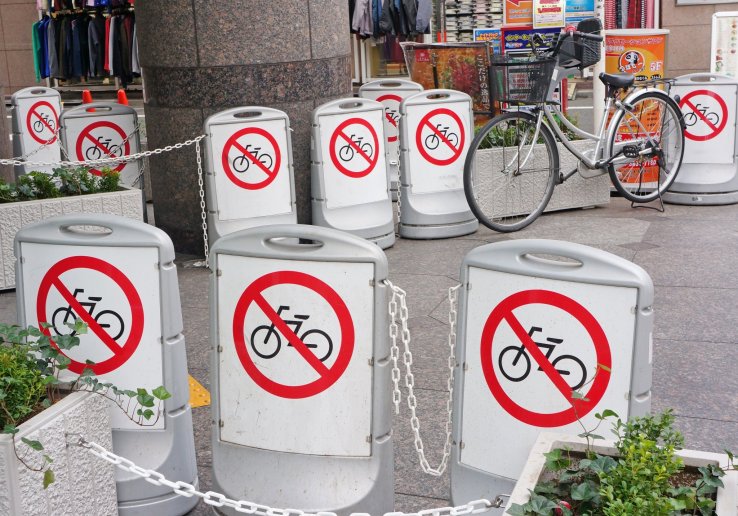
This is usually less of a problem for rental cycles only parking temporarily, but more for those with have their own bike e.g. for commuting to work.
Around train stations and shopping malls, there are usually designated parking lots. Some are free and open-air while the sheltered ones may be charged. Parking fees can be calculated for short-term and long-term usage.
-
For short-term use, you can choose to pay by the hour, and the parking fee is always rounded up to the nearest hour. Alternatively, you can choose to pay for an entire day of parking. The parking hours are usually from 5am to 12am.
-
As for long term use, more economical parking plans are usually available but often limited on a waiting list system.
While cities may be more strict about improper parking, rural areas may be more lax about it, allowing cyclists to chain their bicycles to sidewalk railings.
That said though, always look out for the “no parking” sign (“駐輪禁止") and be considerate where you choose to park your bike!
Blue Ticket system for fines
Starting April 1, 2026, authorities introduced stricter enforcement through the Blue Ticket System (ao-kippu seido). Under this system, police officers can issue on-the-spot fines for certain bicycle violations, similar to traffic tickets given to drivers. The rules apply to cyclists aged 16 and older, including foreign residents and visitors.
There are two main ticket colors. The Blue Ticket covers minor violations—paying the fine avoids criminal liability, but if you leave Japan without paying, you may be denied re-entry next time. The Red Ticket is issued for serious violations and may lead to criminal proceedings and a criminal record.
Approximately 113 behaviors are subject to penalties under the new rules. Find the full list here from page 51 to 52 (Japanese only).
For an excerpt, we’ve compiled a list of the most common violations below:
| Violation | Fine |
|---|---|
| Using a smartphone while riding | ¥12,000 |
| Riding against traffic | ¥6,000 |
| Ignoring red lights / stop signs | ¥6,000 |
| Failing to yield to pedestrians at a crosswalk | ¥6,000 |
| Failing to make a complete stop | ¥5,000 |
| Riding without lights at night | ¥5,000 |
| Using umbrella or headphones while riding | ¥5,000 |
| Riding side by side with multiple bicycles | ¥3,000 |
| Riding double (with a passenger) | ¥3,000 |
| Riding on the sidewalk dangerously | Warning or ¥6,000 fine |
And finally
While you may observe many Japanese cyclists flouting the laws mentioned above, remember that they are doing so at the risk of suffering repercussions and also putting others in danger. Overall, aim to be a considerate and alert cyclist who behaves responsibly for your own safety and those of others.
Cycling in Japan is generally safe and convenient, which makes it all the more important to help maintain that standard. By staying aware of your surroundings, following the rules, and showing consideration to pedestrians and fellow cyclists, you’re actively contributing to a more respectful and predictable road environment, Safe cycling, though, isn’t just about avoiding penalties. Learn to build good habits that protect you and those around you.